Study Topics
The Computational Cognitive Developmental Lab’s research focuses on the underlying mechanisms of important cognitive abilities. Current studies primarily focus on children’s causal reasoning and word learning. Previous research has focused on children’s causal reasoning and sociomoral development.
Probability and Causality
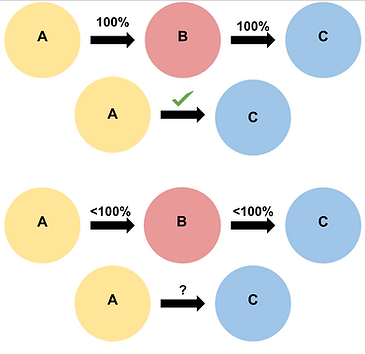
How do children learn associations in different settings? Previous research has shown that in deterministic settings (e.g., X always causes an effect and Y never causes an effect) young children can use directly experiences associations to infer novel associations (e.g., If A causes B and B causes C then A causes C). This study aims to investigate if children can engage in this learning when the setting is more ambiguous (e.g., X usually causes an effect and Y usually does no cause an effect).
Explanations and Causality
How do explanations boost causal learning? Prompting children to provide explanations has been shown to boost children's learning in a multitude of domains, including understanding cause and effect relations (e.g., "Why did X happen?"). This study is designed to examine the underlying cognitive mechanism(s) that might be driving children's causal inferences when they are prompted to explain something they see. In other words, we're interested in what information is prioritized in children's minds when they are asked to explain an observed effect and asked to make inferences!

Statistical Learning
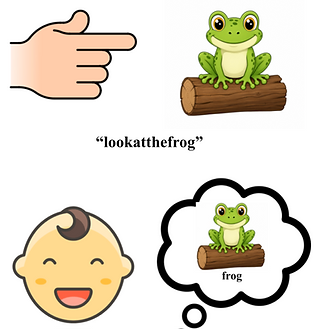
How do babies learn to pick out words from continuous speech? One theory for how infants achieve this is called statistical learning: an ability to pick up patterns in speech to recognize words while learning language. This study explores how children may learn these patterns and how this ability relates to other aspects of development. Through behavioral experiments and neural network models this research aims to better understand the learning processes that support early language acquisition.
Features and Causality
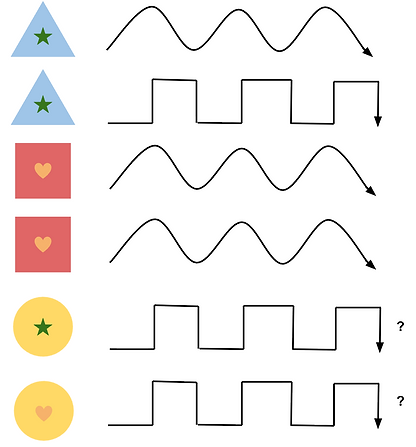
How do babies learn to make connections between what they see and what happens next? One way may be through associative learning, the ability to learn that certain features, objects, or events are connected through repeated experience. This study explores whether infants can flexibly learn that one feature of an object is associated with multiple actions, while another feature is associated with only one, and whether they can generalize these associations to new objects. By examining how infants respond when these learned associations are maintained or changed, this research aims to better understand how associative learning supports infant developing knowledge about the world.